Transformation Strawinskyhuis
| Client | Strawinskyhuis B.V. (FLOW Real Estate & Egeria Real Estate Development) |
| Completion time | 2021 - 2023 |
| Market | Commercial real estate |
| Team | |

| In collaboration with | ZZDP Architecten, Du Prie bouw & ontwikkeling |
| Location | Amsterdam |
| Project scope | 10.587 m2 bvo |
| Expertises | |
From maze to sustainable office building
Amsterdam’s Strawinsky House dates back to the 1970s and has been renovated several times since. The resulting maze of winding, narrow corridors made it difficult for visitors to find their way. The assignment? Create a sustainable office building with a new, modern appearance, both inside and out. The building was stripped down to its concrete shell. The existing concrete load‑bearing structures from 1972 and 1991 formed the foundation for the renewed building.
Sustainable structure
When optimising the main load-bearing structure, the focus was on three aspects:
- minimising environmental impact
- creating a smarter design for the concrete structure
- using materials more efficiently through intelligent shaping
The decision was made to retain the concrete structure rather than opt for new construction. The building was in good condition and offered sufficient structural possibilities. Moreover, this approach was more feasible given the building’s location in the bustling international knowledge and business district of Amsterdam, where there is significant traffic activity. Through close collaboration with the executing parties, it was made possible to integrate the design into the existing structure.

Technical feat
One of the greatest challenges in this project was the replacement of the existing façade. The original high edge load from the façade changed, requiring a full verification of the structural floor system. What made the situation even more complex was the fact that part of the existing floors consisted of post‑tensioned concrete, an innovative technique at the time to create slender structures. Thanks to the use of advanced calculation software, ABT succeeded in extending the building’s lifespan by several decades in the new design. The floors were stiffened using carbon laminate reinforcement.
To achieve a consistent façade rhythm, two concrete façade columns had to be replaced by a single column. A new supporting structure was therefore added to transfer the weight of the upper floors down to the foundation. By using creative (engineering) solutions, we were able to maintain the integrity of the modern new design with minimal concessions to the building’s aesthetics.
Striking façade cladding
The new façade cladding is a true eye-catcher. The former grid cladding has been replaced with vertical brickwork using elongated bricks in a friendly, light sandy colour, finely detailed and elegant in the building’s rhythm. The colour refers to the previous façade, while the staggered texture adds a distinctly brutalist expression.
Entrance and rooftop landscape
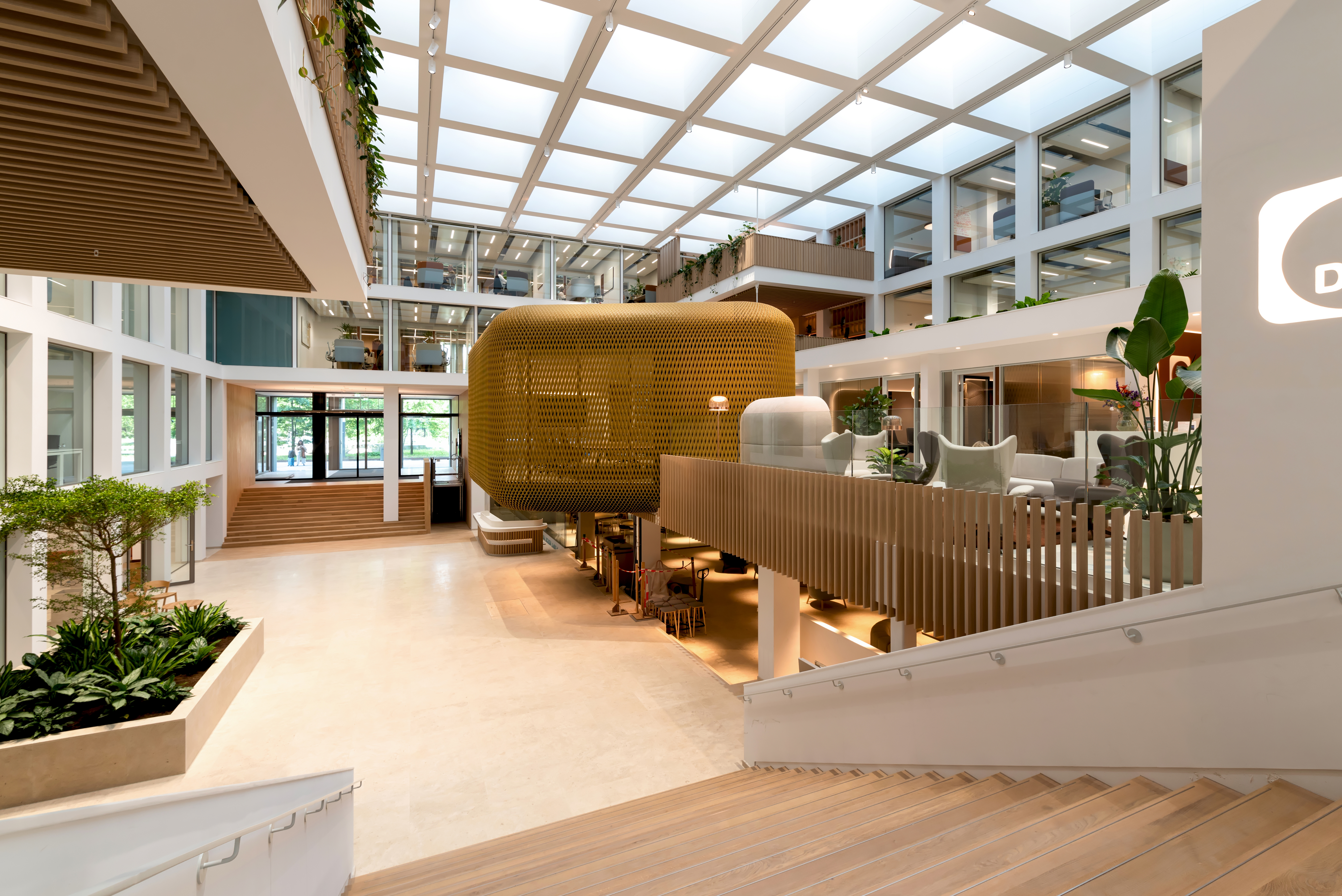
One of the most significant interventions was the creation of an atrium using sustainable materials and several cantilevered staircases, resulting in a generous, ground‑level entrance. The rooftop landscape on the third floor was also thoroughly redesigned. Here, the bitumen roofing and technical installations were replaced by a penthouse, terrace, and green areas. The remaining section has been equipped with solar panels.
Installations
Another challenge was finding sufficient space for the modern building services. The ceiling height of 3.30 metres allowed for very little room. To create as much visual space as possible, open ceilings with climate islands were chosen. Thanks to the new building envelope, the energy demand has been significantly reduced, allowing the installations to be designed with lower capacity.
Ready for the future
The transformation of the Strawinsky House, with its structural feats, is a textbook example of successful inner‑city construction. As a result of this transformation, a high‑quality and future‑proof office building has emerged. Thanks to its sustainable approach, the building has been certified BREEAM Outstanding and was nominated for the 2024 Concrete Award in the Existing Buildings category.

