Ziekenhuis St Jansdal
| Client | Ziekenhuis St Jansdal Harderwijk |
| Completion time | 1985 - 2026 |
| Market | Healthcare |
| Team | |




| In collaboration with | Wiegerinck Architecten, IAA Architecten, Goossen te Pas, Unica, Halmos installatieadviseurs, Hoppa procesmanagement |
| Project scope | 44.000 m2 bvo |
| Expertises | |
Thinking from the basic structure
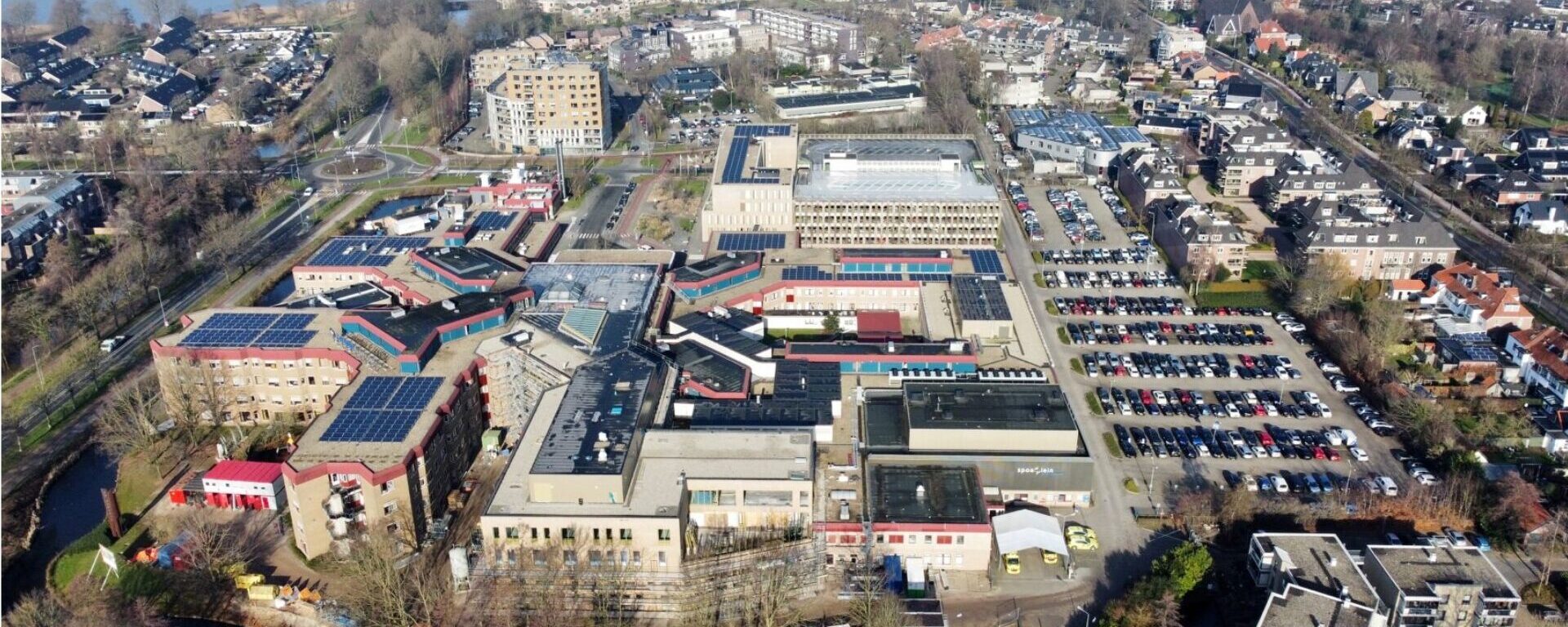
The hospital is built around a powerful and well-thought-out structure: a central heart with an entrance, hall, and elevators, to which four wings are attached. Each wing has its own function; from wards and facilities to outpatient clinics. Thanks to this logical structure, departments could be easily accessed over the years, and the complex could be expanded step by step without compromising continuity of care. New functions, such as a rehabilitation center and a parking garage with an integrated ‘care facade’ for dialysis and mother-child care, among others, connected seamlessly to the existing building thanks to this foundation.
Always evolving
The first questions regarding modifications arose in the mid-1990s, when the mortuary needed to be renovated. From the 2000s onwards, larger expansion and renovation projects followed: space for rehabilitation day treatment, a large sports hall, expansion of the outpatient clinic, a new operating room complex, a new radiology department, revitalization of the hospital pharmacy, and a new main entrance. In each case, interventions were carefully integrated into the existing structure.
Future-proofing comes first
In 2010, the Board of Directors, together with ABT and other partners, devoted considerable attention to the future-proofing of the hospital. The central question was: is renovation and phased growth wiser than complete new construction? The conclusion led to the drafting of a master plan that focuses on the preservation and further development of the existing complex.
The master plan works towards a healthcare environment that:
- is flexible and adaptable;
- offers room for growth and changing healthcare demand;
- is based on the maximum utilization of existing structures;
- can be realized step by step while the hospital remains operational 24/7.
Core of the Master Plan
The master plan is currently in full swing. This is being carried out in phases, aligned with the continuity of care.
An important part of the master plan is the addition of two floors to the top, which makes optimal use of the remaining capacity of the existing building. A flexible plan has been developed that builds upon the original building structure, featuring open column structures that fit the associated budget. For instance, the radiology department (completed in 2020) was constructed using a robust prefabricated concrete structure with load-bearing facades, columns, and wide slabs. This ensures that the floor areas remain flexibly divisible, making the building future-proof and prepared for potential adaptations to the ever-changing demands of healthcare. For this department, significant attention was also paid to the construction for the placement of the new scanning equipment on the floors, given the high weight and the need for vibration-free installation. Removable facade sections have been installed to facilitate the relocation of the MRIs.
In addition to the added floors, two new building sections, Zuid and X, are also part of the master plan. The intensive care unit, cardio care unit, pediatric ward, and oncology department are located in the South building section (completed in 2023). This section is divided into large, flexibly configurable spaces using hollow-core slab floors and precast concrete structures. Consequently, interior walls can be removed relatively easily, allowing the floor plan layout to be easily adjusted in the future. Building section X serves as temporary accommodation during the revitalization and will later be the location for the ophthalmology clinic and nursing ward. In addition to the new-build revitalization, enormous savings are achieved regarding CO2 emissions from materials through maximum preservation of the existing building’s value. Both new sections connect seamlessly to the existing structure, including new basement areas that optimize logistics and circulation routes.
Sustainable structural choices
ABT investigated the possibilities of implementing sustainable choices in the structural design, including the use of more environmentally friendly concrete in accordance with the Concrete Agreement. In the ward building, floors have been locally reinforced with carbon fiber reinforcement due to new openings and shafts.
Smart healthcare logistics and optimal well-being
The integrated approach extends beyond the structure. To make the care process and logistics processes more efficient, care has been taken to ensure that the new construction and existing buildings flow seamlessly into one another. Breakthroughs have been created in the facade, and in the South section, a new basement has been constructed in the corner of the building to improve logistics processes and circulation within the hospital. The new basement connects to the existing basement.
A new goods lift from the basement and a smart chute system for linen and waste accelerate and make logistics processes more efficient. Additionally, less stock is required in the departments, resulting in extra workspace. In addition, the design focuses explicitly on creating a healing environment and on the well-being of patients and staff: more daylight, views of greenery, and amenities such as balconies and roof terraces for patients who cannot go outside.
Low-disruption execution
ABT worked with the construction team on an execution strategy aimed at minimizing disruption:
- steel foundations where possible;
- vibration- and noise-reducing piling systems where necessary;
- maximum prefabrication to limit construction time and nuisance;
- phased relocation plans aligned with the operational hospital.
A vision that is never finished
The master plan for St Jansdal is not an endpoint, but a guiding framework. Healthcare continues to change, and the hospital changes with it. By building smartly on the existing structure, it remains possible to logically add new functions, renew departments, and optimize facilities. In this way, St Jansdal has been growing from the same foundation for more than thirty years, and the hospital remains ready for the healthcare of tomorrow.